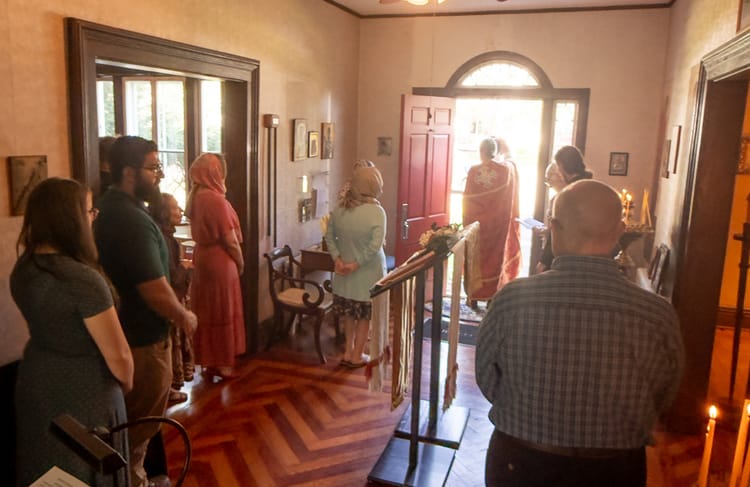
Trapeza Talks: The Etiquette of the Liturgy!
#3: Candles: Celebrating Christ, the Light of the World!
Question: "Why do we light candles in the Church?"
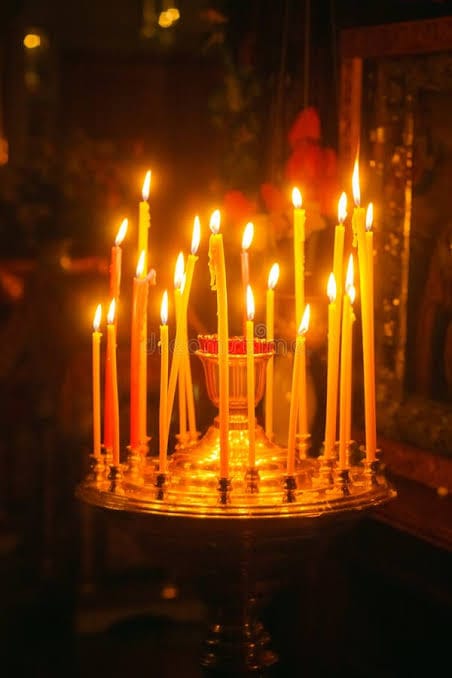
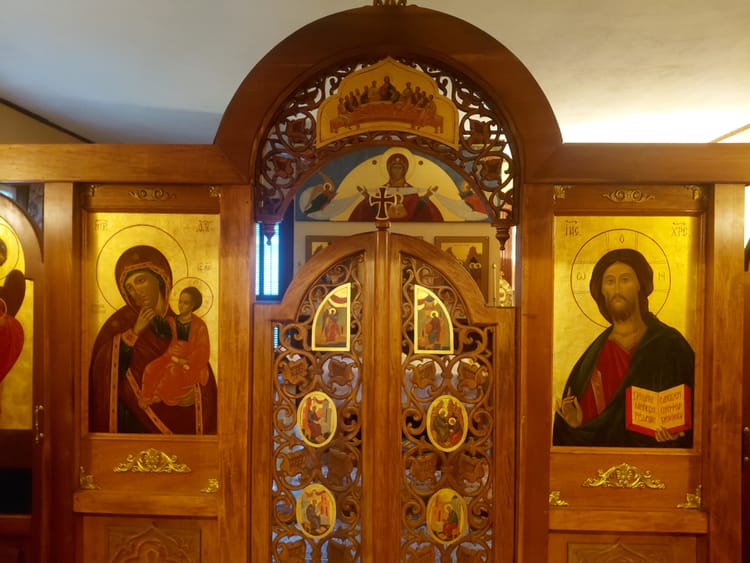
Still another striking feature we are brought face to face with upon entering an Orthodox Church is that it is ablaze with…candles! Lights, in fact, are usually dimmed low to allow the glow from yellow, bees wax candles to shine brightly. The candles, however, are not indiscriminately scattered throughout the church, but rather are placed in stands or sand-filled containers in specific locations. The most prominent and usual of these locations are the entrance narthex, in front of important icons in the Nave or main area of the Church, as well as a memorial area for the departed.
I remember a couple of young, first-time visitors not just to the Chapel but to any Orthodox Church who arrived early one Sunday morning. The man decided to check it out first for his girlfriend to make sure it was "safe" for both of them to come in. As he peered through the window, he noticed a sand-filled box ablaze with candles. Satisfied with his reconnaissance, he went back to his car to report his findings to his girlfriend: “I don’t know exactly what’s going on in there," he relayed, "but someone must be having a birthday, because there’s a huge cake filled with lit candles!”
Although we may smile at this, this first time visitor (now a baptized member with his now wife of an Orthodox Church in Albany) was actually spot on. In a very real way, when we come into Church and light a candle, we are indeed celebrating our rebirth in Jesus Christ, the Light of the world! As Christ says, “I am the Light of the world, whoever follows Me will not walk in darkness, but will have the Light of Life!” (John 8:12)
Taking a deeper dive, our spiritual birth specifically takes place at our baptism. After Jesus explained to the enquiring Nicodemus what made His Life so different, he said to him, “Nicodemus, you must be born again!” (cf. John 3:3) What exactly did Christ mean by this? Jesus gives us the answer as he says to Nicodemus, “Truly I say unto you, no one can enter the Kingdom of God unless they are born of water and the Spirit.” (John 3:5) Being born of water and the spirit is what takes place as we receive the sacraments of Baptism and Chrismation as we enter into the Church. This is the time of our rebirth!
Therefore as we light a candle in the church, we are indeed celebrating our birthday into the Kingdom of God! Notice, however, the complete change of emphasis from our physical birthdays. On our physical birthdays, it is all about us. On our Spiritual birthdays (every day we enter the Church), it is all about Christ Who has saved us from our wretched lives and given us new life in Himself!
It is this change of orientation that makes all the difference. Now it is no longer about ourselves, but about Christ. Now it is no longer our being puffed up in our pride, but about our being humbled to cry out to the Lord. Now it is no longer about our self-sufficiency to do all things, but about our prayers to Christ and His Saints to make us like Him and them! And because of this change in orientation, we can begin to pray for others as well.
This is what we do as we come to light our candles in Church. We glorify Christ the Light of the world who has called us out of our darkness into His marvelous Light. We humbly ask His forgiveness and His help as we prepare to enter into His Church to worship Him, to come to Him in Confession, and finally to receive His Body and Blood. And we present our requests to Him on behalf not only of ourselves, but on behalf of others as well. Included in this group are those who have reposed in Christ, that the Lord would have mercy on them as well.
I remember today with great sorrow the time in my life when I was running away from God, and living my life as though God did not exist. I was living in South Florida at the time, and that is where God did something extraordinary to begin to awaken me to the reality of Himself. He brought a hurricane. At the time I thought little of it, as I dutifully boarded closed all of the windows to our house near the ocean.
The hurricane came and went. We lost all electricity, but so far, so good. Since, however, I was obviously missing the point, God upped the ante. He brought a second hurricane a week later. What this meant is that we had to leave all the boards on the windows until the second one also passed. And that was when I felt the darkness – what it meant to be without light! It was then that I realized: this is what hell is like: "the land of the outer darkness" (cf. Matthew 22:13).
Today you and I can both experience this feeling of darkness on the evening of Pascha. At precisely 12 o’clock midnight, all the lights will go out in the Church. We will be in total and abject darkness. And then suddenly, in the alter, a single light will illumine the Paschal candle. Bearing this light, the priest will come out of the alter and stand before the assembled people waiting in darkness. Then, with clarion voice he cries out, “Come! Take light from the Light that is never overtaken by night! Come! Glorify Christ, risen from the dead!” And with this proclamation, the congregants will take light from this Light and pass this light onto the others until suddenly all the Church is ablaze with the Light of Christ as singing begins, “Christ is risen from the dead!” This is the reason we light candles in the Church!
#2: Icons: Becoming Like Christ!
Question: "Why do we venerate icons in Church?"
As we come into the Orthodox Church on any given Sunday, whether for the very first time, or perhaps as a “cradle Orthodox,” we can sometimes be immediately overwhelmed by our sensory perceptions of all that is taking place around us. I remember the very first time I went into an Orthodox Church, I was a college student visiting Moscow on an economics study program. This, of course, was in the days of full-blown communism, and our guide brought us that day to an Orthodox monastery.
I’ll never forget what happened. As we entered the smoky and cavernous sanctuary my first thought was that I had stepped into the biggest art museum I had ever visited, including the Louvre! There were no seats, but the many people would scurry about from one painting to the next. Instead, however, of pausing and intellectually evaluating the work of art, the worshippers were bowing and crossing themselves vociferously, then kissing the works of art and bowing and crossing themselves some more before going on to the next one. Of course, I had no idea what I had just walked into. Little did I know then, but I would later spend years of my life trying to make sense of it all.
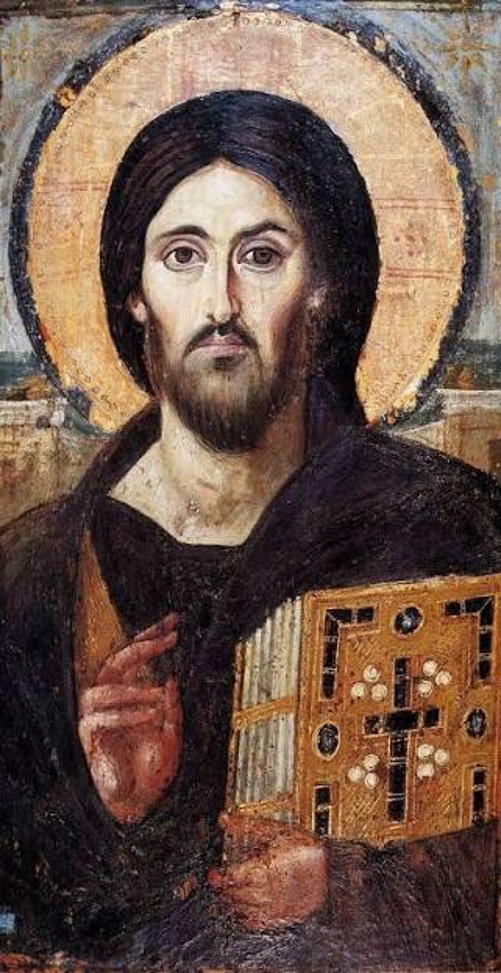
What I experienced that day on a grand scale, however, is what visitors and congregants alike experience every time they come to Church, venerating not pieces of art, but icons. Just what are icons? Icons have been called “windows to heaven,” and are the pictorial displays of Jesus Christ, Mary, the Mother of God, the angels and the saints. In Hebrews we read, “Therefore, since we are surrounded by so great a cloud of witnesses, let us lay aside every weight, and the sin which so easily ensnares us, and let us run with perseverance the race that is set before us.” (Hebrews 12:1) This “cloud of witnesses,” of course, is the Saints, and in an Orthodox Church they literally do “surround us” as they are featured in the displayed icons of the Church.
As you arrive in the Church, you will see other worshippers doing exactly what those worshippers in Moscow were doing: crossing themselves (cf. The Etiquette of Liturgy, talk #1, below: “Signing Ourselves with the Sign of the Cross!”), bowing, kissing the icon and signing and bowing again. Why is this? What is so special about these icons that merit and command such attention and respect? The answer to these questions lies in who these saints whom we are venerating are. The Saints are those who have achieved the purpose of our salvation, which is theosis, or God-likeness. The Saints, in other words, are those who have achieved all that we are working towards! They are those who have “been there” and “done that,” and can, as a result, help us through their prayers as well.
"But wait a minute," we might object, "these 'saints' are dead, and not still living, right?" Wrong! As Jesus made clear to the Sadducees, God is the One who met Moses in the Burning Bush and said, “I Am the God of Abraham, Isaac and Jacob! He is not the God of the dead but the God of the living!” (cf. Mark 12:36 & 37) The Saints, whose images are depicted in the icons of the Church, are, as a result, very much alive! In Revelation, in fact, we are told that their prayers for the Church (us!) arise to the very Throne of God: “Now when He (Christ the Lamb) had taken the scroll, the four living creatures and the twenty-four elders fell down before the Lamb, each having a harp, and golden bowls full of incense, which are the prayers of the saints.” (Revelation 5:8)
The saints then are alive and pray for us as we venerate their icons. But what are they praying for us about? They are praying that we might become like them, that we might become like them who have become like Christ! "But wait a minute," we might protest again, "just why is it again that we should want to become like them…? Weren’t most of them poor and martyrs?!" Exactly! They are those who in their poverty, sufferings, and oftentimes martyrdom teach us the way of Christ, the way of κένωσις (“kenosis”), the way of emptying ourselves that we might become filled with God.
In other words, it is the saints who teach us more than anyone else that the way up… is down! Isn’t this exactly what the Apostle Paul teaches us: “Be ye imitators of me as I am of Christ Jesus!” (I Corinthians 11:1) As for Christ, He voluntarily in “extreme humility” (the name of the icon depicting Christ’s death) emptied Himself of all and gave Himself over to death, even death on a cross. The Result: “Therefore God has highly exalted Him and given Him the Name that is above every Name, that at the Name of Jesus every knew should bow and every tongue confess that Jesus Christ is Lord to the glory of God the Father!” (Philippians 2:5 – 11)
Paul for his part did the same thing: he became the "slave of Christ" even to his own martyrdom in Rome. So also are we to go and do likewise as well. Of course, we can’t do this on our own. Because of this, we have Christ and His saints depicted on the icons to help us follow in their steps. The result of this self-emptying in emulation of the saints depicted on the icons will be the very fulfillment of our personhood, the fulfillment of our becoming the people Christ created us to be.
The icons, therefore, teach us that our God is with us – that He is not a God that is far off. This truth is illustrated in the very way that icons are “written,” or painted. Using inverse perspective, the lines of the icon don’t converge as in traditional art creating a vanishing point somewhere out there on the distant horizon. Rather the lines diverge creating a vanishing point that is actually in front of the canvas where we are! The result is to bring us into the icon itself so that we can join the saints to become like them! Instead, therefore of depicting a God who is far off, in another room or in another world, Christ has become incarnate for us and entered our world, that we might enter His. As Saint Athanasius famously said, “God became man so that man (by His grace) might become God!"
#1: Signing Ourselves with the Sign of the Cross!
Question: "Why do we sign ourselves with the sign of the Cross in Church?"
This morning we are beginning a new series taking a few minutes at every Sunday's Trapeza to explore what we are calling The Etiquette of the Liturgy! In many ways, as we look at the etiquette of the Liturgy, we are looking at the external trappings of the worship of the Church to get a better understanding of what takes place each Sunday. Not only, of course, is this helpful for those who have just started coming to the Orthodox Church, but also for all of us to explore in greater depth what lies behind the otherwise sometimes perfunctory actions we perform week in and week out. Take, for example, signing ourselves with the sign of the cross. As we enter the Church each Sunday, invariably we find ourselves surrounded by those who are crossing themselves. But what actually does this mean to sign ourselves with the sign of the cross and why is it that we do it?
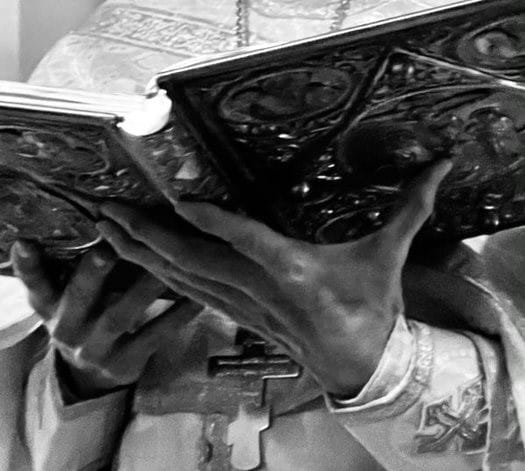
Well, first of all, how do we sign ourselves with the sign of the cross? The sign of the cross is made by taking our right hand and touching it first to our foreheads, and then to the stomach, next to our right shoulder and finally to the left shoulder. As we do this, we ask God for His protection of all our life, beginning with our mind, and then with our heart, and will and emotions, and finally with the service of our life. As we do so, we are, following Christ as He says to us, “If anyone would follow Me, let him deny himself, take up his cross and follow Me.” (Matthew 16:24)
But just what kind of a God are we following as we do this? Our right hand tells us the answer. As we look at how we hold our hand a little bit more closely, we notice first of all that our index and middle fingers are joined together with our thumb to form a trinity. As they do so, we are specifically signifying the Holy Trinity! The great mystery of the Holy Trinity is thus proclaimed even with the way we form our hands while making the cross! That our God is One God we signify by bringing together our first two fingers and our thumb as one. That this One God contains in Himself three separate Hypostases, or Persons, is signified by the distinct digits that we bring together to form this Unity!
Thus, the Father is uniquely worshipped and glorified as the Unoriginate One from whom the other two Persons of the Trinity come “before all ages.” This is referred to as the “monarchy” of the Father. The Son’s uniqueness comes from His being the Only Person of the Trinity to be Begotten of the Father. The Spirit also is unique from both the Father and the Son as the only God who proceeds from the Father. Nevertheless, while each One is unique, all Three share the same substance or essence, and therefore are equally God!
We thus affirm this One God existing in Three Persons every time we cross ourselves! In addition, we proclaim this God every time we say the Nicene Creed: “I believe in One God, the Father Almighty, Maker of heaven and earth, and of all things visible and invisible… and in One Lord Jesus Christ, the Son of God, the Only-begotten, begotten of the Father before all ages, Light of Light; true God of true God; begotten, not made; of one essence with the Father, by Whom all things were made… and in the Holy Spirit, the Lord, the Giver of Life; Who proceedeth from the Father Who with the Father and the Son together is worshipped and glorified.”
As we, however, take an even closer look at the hand with which we cross ourselves, we discover that the ring and little fingers are also proclaiming through how they are positioned more about the Great God we follow! Their focus, however, is not on the Trinity, but on Jesus Christ Himself who for His part is One person, or hypostasis, in two natures! Specifically, we proclaim about Christ that He is the only one to be fully God and fully man.
How so? Christ is fully man as a result of His taking in Himself our own flesh as a result of being born of the Virgin Mary. At the same time, however, He is fully God by virtue of His being born also of the Holy Spirit! This, of course was necessary in order for Christ to secure our salvation through His being the perfect Second Man, or second Adam, who completely obeyed His Father in Heaven on the one hand, but yet nevertheless suffered for us on the cross that we might die to our sins and have victory over Satan and death through His resurrection!
This great truth, for its part, is also expressed in our Creed: “Who for us men, and for our salvation, came down from the heavens, and was incarnate of the Holy Spirit and the Virgin Mary, and became man; and was crucified for us under Pontius Pilate, and suffered, and was buried; And arose again on the third day according to the Scriptures; and ascended into the heavens, and sitteth at the right hand of the Father…”
This Lord Jesus Christ and Holy Trinity is therefore the One Whom we proclaim every time we sign ourselves with the sign of the cross! It is therefore little wonder that it is before this sign of the cross that Satan and the demons tremble and flee! Why is this? Because it was precisely on the cross, that Christ crushed the head of Satan and defeated him. He now gives this cross to us that we too might have victory over Satan and the demons every time we sign ourselves with the sign of the cross!